
Duplin Scheduled and Actual Release
A projected, scheduled, or tentative date is a current estimate based on records and rules available to the calculating agency. An actual release date records that the custodial event happened. NC DAC may update a projection when it receives a revised judgment, applies sentence credit, changes earned credit, resolves consecutive terms, or learns of another hold. The two dates should remain separately labeled even when they match.
Pretrial custody works differently. A person held at the Duplin County Detention Center may leave after bond, dismissal, a court order, or another legal change. Until that event is authorized and processed, there may be no calendar date comparable to a prison projection. A local sentence may have a known endpoint, but Duplin County did not publish a jail sentence-computation policy in the sources reviewed.
Note: A court order can authorize release before the jail completes processing, so compare the order and custody timestamps.
Duplin County Release Date Steps
The correct route depends on whether the person is in the county jail, state prison, supervision, or another system. The Duplin County released inmate search provides the full records path when custody type is uncertain. For a state sentence, begin with the official DAC tools rather than the county's current booking screen.
- Identify the holding agency. Check whether the person is at the Duplin County Detention Center, in NC DAC custody, or held under another jurisdiction.
- For state prison, open the Offender Public Information Search and match the name, birth details, descriptors, and offender number.
- Read each incarceration and sentence entry. Record the projected date exactly as labeled and note the day it was checked.
- Review the Duplin court judgment for sentence terms, confinement credit, amended orders, and concurrent or consecutive structure.
- For a local jail sentence or pretrial matter, call detention at 910-296-2324 and use the Duplin Clerk for the court authority.
- Register with NC SAVAN for a custody-change alert, then return after the expected date to retrieve the executed release entry.
Do not use DAC OPI as a complete archive of short Duplin jail stays. It is strongest when the person entered state prison or community supervision. In the other direction, Citizen Connect cannot establish a later state prison discharge.
NC DAC Duplin Release Fields
OPI accepts combinations of surname, given name, gender, race, birth date or age, and offender number, depending on the form. Search with the least ambiguous combination and open the matching person record. The official interface below shows the search fields. Use the live OPI search because field labels and screens can change.
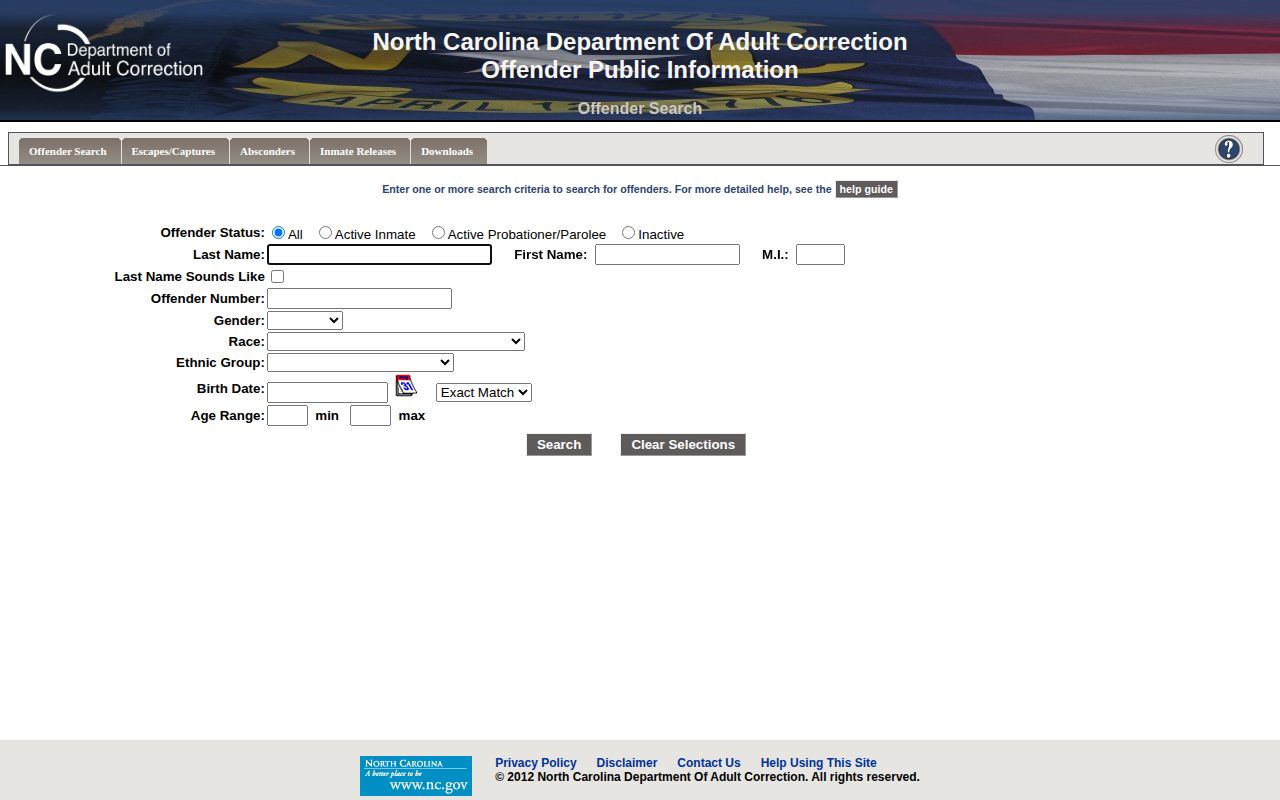
The form begins identity matching; the detailed incarceration, sentence, release, and supervision sections provide the context needed to interpret a date.
| OPI area | How it helps |
|---|---|
| Offender identity | Confirms the offender number and descriptors before dates are combined. |
| Incarceration history | Shows prison episodes, admission context, and custody entries. |
| Offense and sentence | Shows the judgment terms that shape the current calculation. |
| Projected release | Shows DAC's current prospective calculation, not proof of departure. |
| Actual release history | Records an executed state custody release with date and type when displayed. |
| Supervision history | Shows whether probation, parole, or post-release supervision remains active. |
An inactive prison status may coexist with active supervision. That combination often means confinement ended and community supervision began. It does not mean every part of the sentence has been discharged.
Duplin Release Dates and Sentencing
North Carolina Structured Sentencing cannot be reduced to a claim that everyone serves 85 percent. G.S. 15A-1340.17 establishes ranges and relationships between minimum and maximum terms. G.S. 15A-1340.13 addresses service of the minimum term, subject to the governing law. Crime class, prior-record level, offense date, judgment structure, and special provisions all matter.
Post-release supervision is part of the maximum-term framework under G.S. 15A-1368.2. It is a community supervision period after prison, not extra prison time and not a synonym for parole. A person can therefore have an actual prison release date while still having an active sentence component in the community.
- Minimum term
- The sentencing component generally served before release under the applicable structured framework.
- Maximum term
- The longer statutory term that accommodates release mechanics and post-release supervision.
- Projected date
- DAC's present sentence calculation based on the information then recorded.
- Actual release
- The executed event ending that prison or jail custody episode.
Note: A percentage shortcut can miss the offense date, judgment structure, supervision term, and credits that control a North Carolina sentence.
Duplin Release Credit Rules
G.S. 148-13 authorizes DAC rules for custody grades, privileges, and gain or earned time. It does not supply a simple public formula that a reader can apply to every sentence. Earned credit is part of an agency calculation tied to the record and governing sentence scheme. It should never be guessed from the maximum term.
Jail credit recorded by the court can also affect the calculation. Review the judgment and sentence entries for confinement credit. Consecutive sentences run one after another, while concurrent terms overlap as the judgment allows. A later amendment or corrected credit can change the displayed forecast without changing the original conviction date.
Duplin County did not publish a local good-time computation policy in the reviewed sources. For a county sentence, ask detention about the apparent scheduled date and ask the Clerk for the judgment or order. Do not import a rule from another county jail or treat a state prison rule as a local jail promise.
If a calculation record is needed from DAC, search OPI first and use the offender number in a focused follow-up request. Ask for an existing release or sentence-computation record instead of asking staff to create a new date. Some correctional information is confidential, so a public result may show less than the internal material used for the agency calculation. A narrow request preserves the difference between the displayed estimate and its underlying records.
What Changes Duplin Release Dates
A change does not always signal an error. Sentence calculations evolve as courts and custodians receive new facts. Preserve the earlier date and the date it was observed, then record the later value with its own label.
Source timing can explain an apparent conflict. A signed court order may exist before detention completes release processing. A Duplin jail transfer entry may appear before DAC finishes the receiving admission. SAVAN may send an event alert before OPI or another public portal refreshes. Compare the timestamps and the fact each system owns. The court controls its judgment, the jail records its booking exit, and DAC maintains the state sentence calculation. One source should not be forced to answer a different agency's question.
| Factor | Possible effect | Best check |
|---|---|---|
| Judgment amendment | Changes a term, credit, or legal basis used by DAC. | Duplin Clerk and updated OPI detail |
| Concurrent or consecutive terms | Changes whether sentences overlap or run in sequence. | Each judgment and sentence entry |
| Jail or earned credit | Moves the current computation when valid credit is applied or lost. | Court credit and DAC calculation record |
| Discipline or recalculation | May alter credit or correct the sentence computation. | DAC record and official response |
| Detainer or pending matter | May prevent community release or cause transfer to another custodian. | Originating and receiving agencies |
| Parole action | Affects eligible older-law sentences but does not itself prove physical release. | Commission process and executed release |
A detainer is notice that another authority may seek custody. It must be supported by an official record. No Duplin-specific ICE agreement was verified, so a generic hold must not be labeled an immigration transfer without evidence.
Parole Eligibility Is Not Release
For eligible older sentences, G.S. 15A-1371 and the North Carolina Post-Release Supervision and Parole Commission process may apply. DAC explains that parole generally concerns crimes committed before October 1, 1994. Eligibility means the case can be considered under the applicable law. It does not predict a favorable decision or establish a scheduled departure date.
The Commission says it does not conduct formal hearings. There is no public hearing calendar event that can serve as release confirmation, and no public searchable decisions database was found in the research. Modern structured sentences generally use post-release supervision instead. Always identify the sentence scheme before interpreting a parole-related date.
Confirm Duplin County Actual Release
After the expected date, return to OPI and examine the actual release history. The release-specific DAC search can also show releases by date and county-related filters. For a local booking, request the Duplin jail transaction with admit and release timestamps, release type, releasing authority, and receiving agency if public. A disappearance from the current roster does not prove release because transfer, delay, correction, escape, or another custody change can remove or alter a listing.
A Duplin County VINE inmate check can add a timely status-change alert. Reconcile that alert with the executed record. When sources disagree, prefer the jail transaction for the physical end of a county booking, the court record for legal authority, and DAC for a state prison release or supervision status.
Keep a small audit trail when timing matters. Record the projected date as displayed, the date the portal was checked, the sentence entry used, and the later actual-release field. If the forecast changes, retain both values and seek the judgment, credit entry, detainer, or recalculation that explains the change. A correction may be valid even when an earlier screenshot was accurate at the time. Clear labels prevent a past projection from being mistaken for the final Duplin County release transaction.
For a county booking, ask for release time and disposition as separate fields. A court disposition may explain why the jail could release the person, but it seldom records the precise movement through detention processing. Likewise, a SAVAN alert may be prompt without being the county's certified custody record. Each source should be used for the fact it directly maintains.
Note: An actual prison release may begin active post-release supervision, so release from confinement is not always sentence discharge.